Why Joinery Matters in Furniture Construction
Wood expands and contracts with changes in humidity. A piece made in a Canadian winter, when indoor air is dry, will absorb moisture during summer and swell across the grain. Joints that account for this movement — by allowing it to occur without stressing the structure — outlast those that try to prevent it through glue and fasteners alone.
Traditional joinery methods create mechanical interlocks between parts. The dovetail resists pulling apart. The mortise-and-tenon distributes load across a large glue surface and a physical shoulder. The box joint multiplies the gluing area across a series of interlocking fingers. Each approach has specific applications depending on the direction of stress, the species of wood and the visual requirements of the finished piece.
The Dovetail Joint
The dovetail is used where two boards meet at a corner and need to resist being pulled apart — most commonly in drawer construction and the corners of casework. The joint consists of fan-shaped tails cut into one board and corresponding pins cut into the other. The geometry of the tails, which are wider at the end than at the base, means the joint can only be assembled from one direction and cannot be pulled apart in the opposite direction.
Dovetail Proportions
- Hardwoods: slope ratio of 1:8 (about 7 degrees)
- Softwoods: slope ratio of 1:6 (about 9.5 degrees) — steeper to compensate for lower shear strength
- Tail spacing: typically equal to the board thickness, though narrower or wider spacing is a matter of style
- Half-blind dovetails: used where the end grain of one board must not show on the face — common in drawer fronts
Hand-cut dovetails require a marking gauge, a sharp dovetail saw and a set of chisels. The tails are cut first, then the pins are marked directly from the tails using a knife, not a pencil — the narrower the transfer line, the closer the fit. Router jigs and dedicated dovetail machines produce the same joint at production speed, with consistent geometry, though without the slight irregularity of a hand-cut joint that many furniture makers consider part of the aesthetic.
Mortise-and-Tenon
The mortise-and-tenon is the standard joint for connecting rails to legs in tables and chairs, and for frame-and-panel construction in doors and cabinet faces. A tenon — a projecting tongue cut on the end of one piece — fits into a mortise, which is a rectangular cavity cut into the receiving piece. The shoulders of the tenon bear against the face of the mortised piece, carrying the load and preventing racking.

Close work on wood details requires sharp tools and careful measurement. Photo: Wikimedia Commons (CC BY-SA 4.0)
In Canadian furniture, the mortise-and-tenon appears frequently in chairs made from white ash and maple — two species common to eastern Canada that are strong enough to withstand the racking forces a chair frame encounters. The joint is typically glued, and in some traditional applications, a draw-bore pin — a wooden dowel driven through a slightly offset hole in the tenon — draws the joint tight and mechanically locks it.
Tenon Thickness and Length
A common rule of thumb sets tenon thickness at one-third of the stock thickness. Tenon length should be at least equal to the width of the rail being joined, or as deep as the receiving piece allows without breaking through. In chair construction, where the leg is often turned on a lathe, the tenon is round — turned to a consistent diameter — and fits into a bored mortise.
The Box Joint
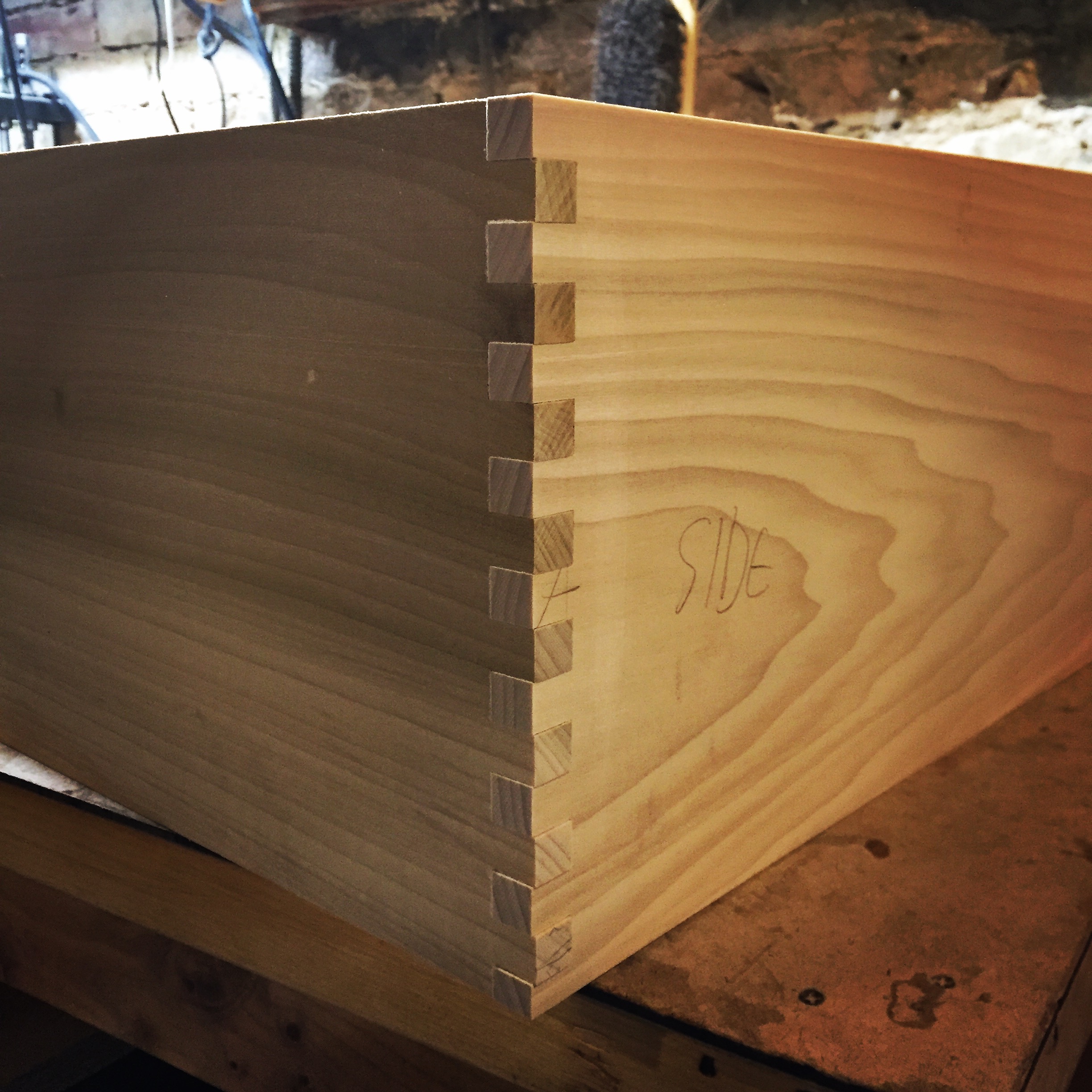
The box joint, sometimes called a finger joint, is used in drawer and box construction where maximum gluing area is needed and the visual pattern of interlocking fingers is acceptable or desirable. Both boards receive a series of evenly spaced rectangular notches. The fingers of one board slot into the spaces of the other.
Box joints are cut efficiently on a table saw or router table using a jig that indexes each cut. The joint has a large gluing surface — often several times the cross-section of the board — which makes it strong when properly assembled. Unlike the dovetail, it has no mechanical resistance to pulling apart and depends entirely on the glue line.
Bridle Joint
The bridle joint resembles an open mortise-and-tenon. A slot is cut across the full width of one piece, and a fork — a tenon with the centre material removed — fits into it. This joint appears in trestle frames, sawhorses and structural frames where the open configuration is acceptable and the joint will be under compression as much as tension. In traditional Canadian timber framing, bridle joints were used in outbuilding construction where the structural members were large-dimension lumber rather than cabinet-scale stock.
Seasonal Movement and Joint Design
Canadian hardwoods move significantly across the grain with seasonal humidity changes. Sugar maple, for example, has a tangential shrinkage rate of about 9.9% from green to oven-dry — meaning a 300mm wide tabletop cut from flatsawn maple could move 25–30mm between summer and winter extremes. Joinery that locks a wide panel rigidly — such as gluing a panel into a groove on all four sides — will split the panel as it expands. Furniture makers account for this by slotting rather than gluing the panel in grooves, allowing the wood to move freely while staying captured.
Resources such as the Wood Database publish shrinkage values for individual species, which are useful when selecting timber for a specific application and designing the joints accordingly.
Hand-Cut vs Machine-Cut Joints
Both approaches produce functional joints. Hand cutting requires more time and skill to execute consistently but allows the maker to fit each joint individually to the actual piece of wood, accounting for any irregularities in dimension or grain. Machine cutting — using a router table, table saw or dedicated jig — produces repeatable geometry quickly and suits production or batch work.
The choice depends on the type of work, available equipment and the standards of fit the maker is working toward. Many woodworkers use machines to cut to rough tolerance and then fit by hand.
Further Reading
For detailed coverage of joint proportions, cutting sequences and fitting techniques, the following publicly available references are useful: the Natural Resources Canada forest products section covers Canadian timber properties; the Wood Database provides species-specific data on shrinkage, hardness and workability.