The Practical Division of Labour
Most working woodworkers use both categories of tools. Power tools reduce the physical effort of dimensioning rough lumber — milling a board flat, to thickness and to width. Hand tools provide the control needed for final fitting, surface refinement and joinery that requires tight tolerances. The question is rarely "which category is better?" but "which tool removes material faster here, and which gives more control there?"
Workshop size, noise restrictions, budget and the type of work being done all influence the choice. A woodworker in a shared apartment building with noise restrictions has different constraints than someone in a detached garage. A maker producing one-off furniture pieces has different needs than a small shop producing batches of the same component.
Hand Tools: Where They Excel
Hand tools remove material slowly but with a high degree of feedback. A hand plane allows the maker to feel the surface as the cut is taken — to sense when a high spot has been addressed, when the grain is running in the wrong direction and tear-out is beginning, or when the sole of the plane is not contacting the surface flat. This feedback is absent in power sanding and power planing, where the tool mediates the relationship between hand and wood.
Tasks Well Suited to Hand Tools
- Final surface preparation before finishing — a sharp hand plane produces a glassy surface that does not need sanding
- Cutting dovetails — sawing and chiseling to scribed lines on individual pieces
- Paring joints to fit — a sharp chisel removes thin shavings from a mortise wall or tenon shoulder
- Fitting drawer slides and cabinet doors — a block plane removes a shaving at a time
- Working in quiet spaces — a handsaw and a chisel produce minimal noise
- Complex curved shapes — spokeshaves, rasps and card scrapers follow curves that routers cannot
The key requirement for hand tools is sharpness. A dull hand plane requires excessive force and leaves a torn, rough surface. A sharp plane — with an edge maintained at the correct bevel angle and polished to remove the wire edge — takes thin, continuous shavings and leaves a surface that reflects light. Maintaining sharp edges is a fundamental skill and the primary ongoing maintenance demand of a hand-tool-oriented shop.
Power Tools: Where They Excel
Power tools reduce effort in operations that are physically demanding or time-consuming at hand-tool speed. A thickness planer reduces a rough-sawn board to a consistent thickness across its length in seconds. Doing the same operation with a hand plane, on a board of any significant width or length, would take considerably longer and requires a higher level of skill to maintain a flat surface across the full width.

Power tools like the band saw reduce effort for dimensioning and resawing. Photo: Wikimedia Commons (CC BY-SA 4.0)
Tasks Well Suited to Power Tools
- Dimensioning rough lumber — jointer, thickness planer, table saw
- Resawing thick stock into thinner boards — band saw
- Cutting sheet material to dimension — table saw or track saw
- Drilling consistent depth holes — drill press
- Routing profiles and dadoes — router table or handheld router
- Producing identical parts in quantity — router jigs, table saw sleds
Power tools introduce considerations that hand tools do not. Safety equipment — push sticks, featherboards, blade guards — is required for table saw and router table operations. Dust collection is a significant concern; fine wood dust is a respiratory hazard, and Canadian regulations around workplace dust exposure apply in commercial settings. Even in small home workshops, at minimum a dust mask rated for fine particulate and a shop vacuum on power tools reduces exposure substantially.
Noise and Space Constraints
Many Canadian woodworkers work in attached garages, basements or small outbuildings where noise is a consideration — neighbour proximity, occupancy hours in strata or municipal bylaws, or simply the preferences of other household members. A jointer and thickness planer operating together during rough milling generate significant noise. A hand plane, a handsaw and a set of chisels generate almost none.
Small space also limits the footprint of machinery. A cabinet table saw requires clearance on all four sides for outfeed and infeed support. A workbench with a hand plane requires only the bench itself. For a woodworker with limited space, a hybrid approach — using a modest set of portable power tools for rough dimensioning and hand tools for joinery and finishing — covers most furniture-making operations within a compact footprint.
A Starting Tool List
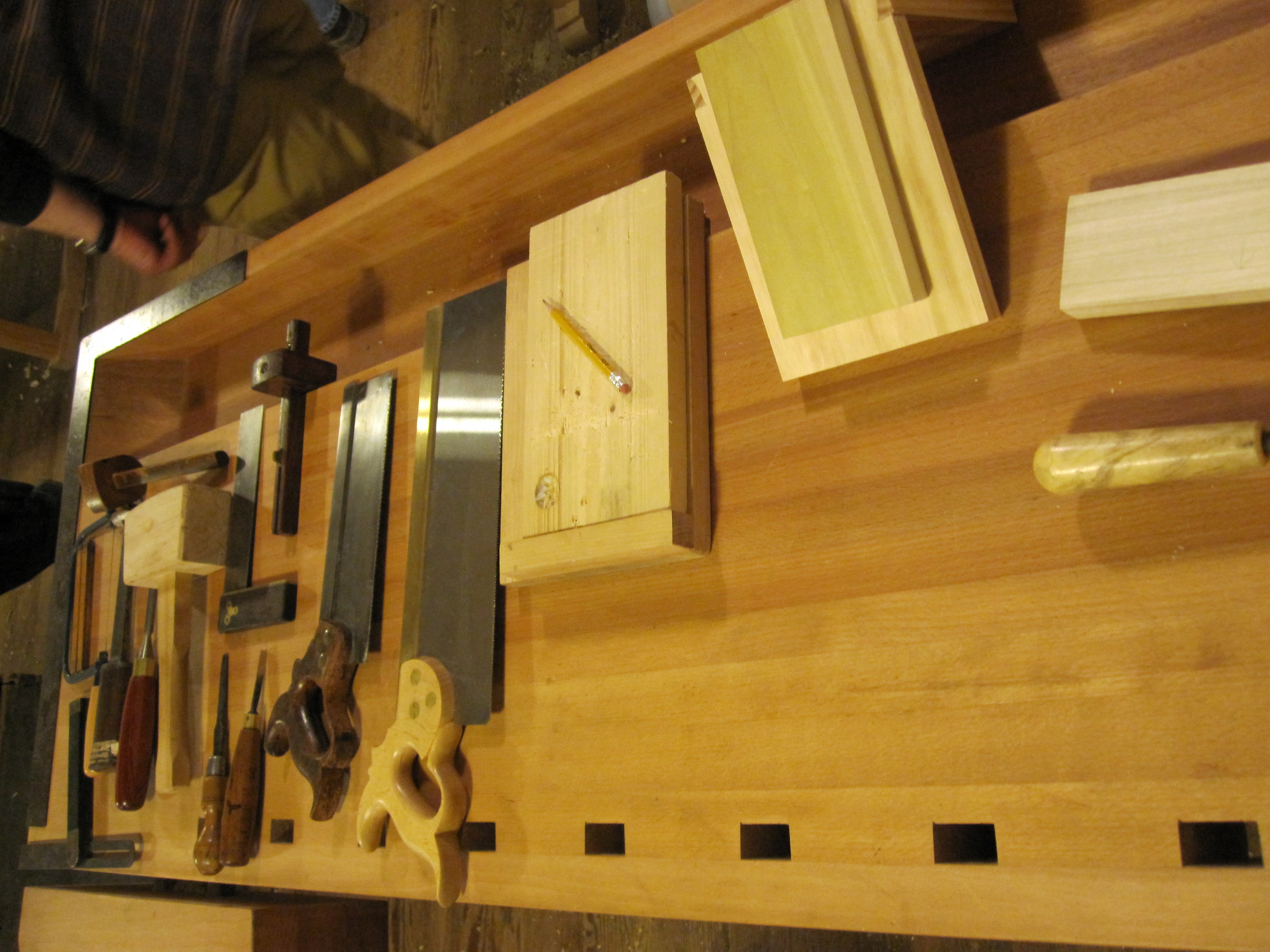
For a woodworker beginning with hand tools, a functional starting set includes: a bench plane for surfacing (No. 4 or No. 5 size), a block plane for end grain and trimming, a set of bench chisels in three or four sizes, a marking gauge, a combination square, a dovetail saw and a rip saw. These tools, kept sharp, allow a wide range of furniture-making operations without power equipment.
For power tools, a table saw and a thickness planer cover the largest share of dimensioning work. A band saw is useful for resawing and curved cuts. A drill press handles consistent drilling. Adding a router table extends the range of joints and profiles available. The sequence in which these are acquired depends on the work being done; a woodworker focused on hand-tool joinery has less need for a router table than one who is building frame-and-panel cabinets with consistent profiles.
Sharpening as a Prerequisite
The performance gap between hand tools and power tools is often a sharpening gap rather than a category gap. A sharp handsaw cuts faster and more accurately than a dull one. A sharp chisel pares to a line without crushing fibres. Many woodworkers who try hand tools and find them frustrating are working with tools that have not been properly sharpened — either because the tool arrived with a factory edge that was not polished, or because it has dulled in use and not been maintained.
Sharpening systems for hand tools range from waterstones to oil stones to diamond lapping plates. Each approach can produce an effective edge. The key variables are achieving the correct bevel angle for the tool type and then polishing the back of the blade flat, which removes the wire edge left by grinding and produces a clean cutting geometry.
References
For additional reference on tool selection and shop setup, the Natural Resources Canada forest products pages cover the material properties of Canadian species that influence tool selection. The Wood Database includes workability notes for individual species — rating their behaviour under hand tools and machine tools separately.